
Keywords
intertextuality
medieval literature
argentine literature
medieval romance
medieval literature
argentine literature
medieval romance
How to Cite
Apuntes sobre la ficcionalización medieval en la literatura contemporánea. (2024). Diseminaciones, 1(2), 89-101. https://revistas.uaq.mx/index.php/diseminaciones/article/view/161
Abstract
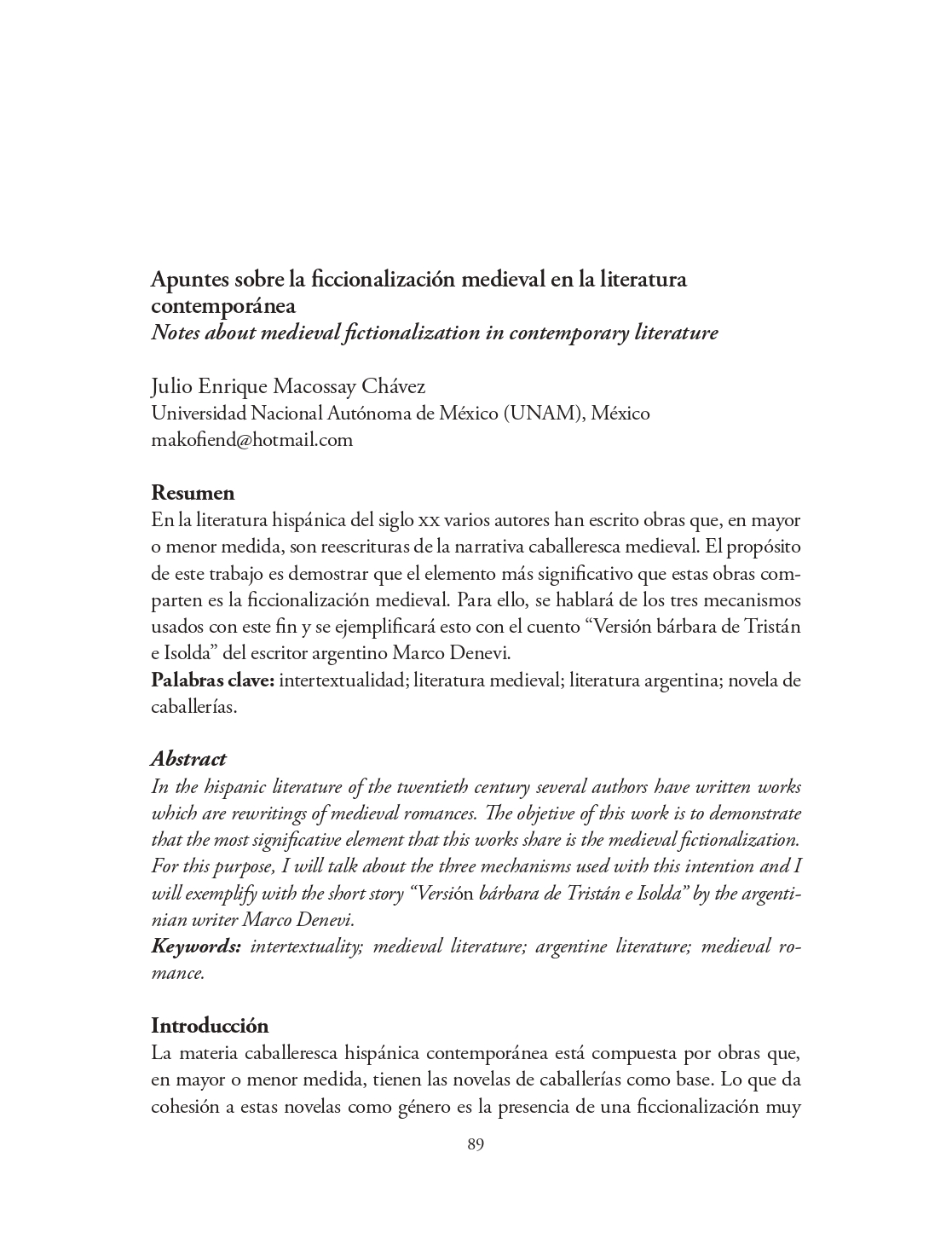
In the hispanic literature of the twentieth century several authors have written works which are rewritings of medieval romances. The objetive of this work is to demonstrate that the most significative element that this works share is the medieval fictionalization. For this purpose, I will talk about the three mechanisms used with this intention and I will exemplify with the short story “Versión bárbara de Tristán e Isolda” by the argentinian writer Marco Denevi.

This work is licensed under a Creative Commons Attribution 4.0 International License.
Copyright (c) 2018 Diseminaciones
Similar Articles
- Felipe A. Ríos Baeza, La larga risa de todos estos años: Efectos del núcleo metapoético en la antipoesía de Nicanor Parra , Diseminaciones: Vol. 2 No. 4 (2019)
- Rogelio Rosado Marrero, “La muerte me da” by Cristina Rivera Garza: writing as “text-corpse” , Diseminaciones: Vol. 5 No. 10 (2022)
- Juan Manuel Tabío, Ansí fabló Omero. Some remarks on the reception of the Ilias Latina in Spanish Medieval Literature , Diseminaciones: Vol. 6 No. 12 (2023)
- Natalia Duque-Cardona, Sebastián Alejandro Marín-Agudelo, Internationalization and interculturality of the curriculum at the Inter-American School of Librarianship (UdeA) , Diseminaciones: Vol. 7 No. 13 (2024)
- Julio María Fernández Meza, Luned, the storyteller: the art of storytelling in El fuego verde by Verónica Murguía , Diseminaciones: Vol. 9 No. 17 (2026): Diseminaciones
- Cecilia Salmerón Tellechea, The Absent City: Ricardo Piglia’s aesthetic and political reading of Macedonio Fernández , Diseminaciones: Vol. 2 No. 4 (2019)
- Daniela Renjel Encinas, An eschatology of the narcotelenovela: visions and versions , Diseminaciones: Vol. 8 No. 16 (2025)
- Adriana Alejandra Coronado Flores, Patricia del Carmen Guerrero de la Llata, The construction of masculinities through corporeity in Cuerpo náufrago by Ana Clavel , Diseminaciones: Vol. 4 No. 8 (2021)
- Laura Gabriela Conde, Didascalias: desubjectivation in the writing and reading of dramatic text , Diseminaciones: Vol. 7 No. 13 (2024)
- Sherly Tania Bustamante Maita, Navigating in the deep rivers of the psychology of José María Arguedas , Diseminaciones: Vol. 9 No. 17 (2026): Diseminaciones
You may also start an advanced similarity search for this article.
Most read articles by the same author(s)
- Leomir C. Hilário, Psychic adhesion to barbarism: crisis, fetishism and subjectivity , Diseminaciones: Vol. 1 No. 1 (2018)
- Jaime Ortega Reyna, The temper of the whole. One hundred years of Theory of the Novel of Lukács , Diseminaciones: Vol. 1 No. 1 (2018)
- Daniela Palma Patiño, Non-linear relationships and resistance strategies of peasant knowledge in San Sebastian Tlacotepec, Puebla , Diseminaciones: Vol. 6 No. 12 (2023)
- Luciana Salazar Plata, Maryse Condé, origins, writing and opacity , Diseminaciones: Vol. 1 No. 1 (2018)
- Jorge Brenes Morales, Extent of the mythical in Landivar’s poem , Diseminaciones: Vol. 4 No. 7 (2021)
- Íñigo Ongay de Felipe, Cartographies of de World, of God and of the Soul , Diseminaciones: Vol. 1 No. 2 (2018)
- Yuricel Moreno Zaldívar, From inhabited space to imagined. Expressions of the social imaginary in the plastic visuality of a Cuban city , Diseminaciones: Vol. 3 No. 6 (2020)
- Clarisa Cruz Sobarzo, Mexican movement of 1968 in “¡Buenos días, señor presidente!” , Diseminaciones: Vol. 5 No. 10 (2022)
- Samuel Lagunas Cerda, Hope and barbarism. Eschatological imaginaries in Rafael Pinedo's 'Plop' , Diseminaciones: Vol. 6 No. 11 (2023)
- Reinalda Soriano Peña, Training for research and creation of educational subjects , Diseminaciones: Vol. 2 No. 3 (2019)
