
Keywords
Resource distribution
Social infrastructure
Political parties
Subnational politics
How to Cite
Abstract
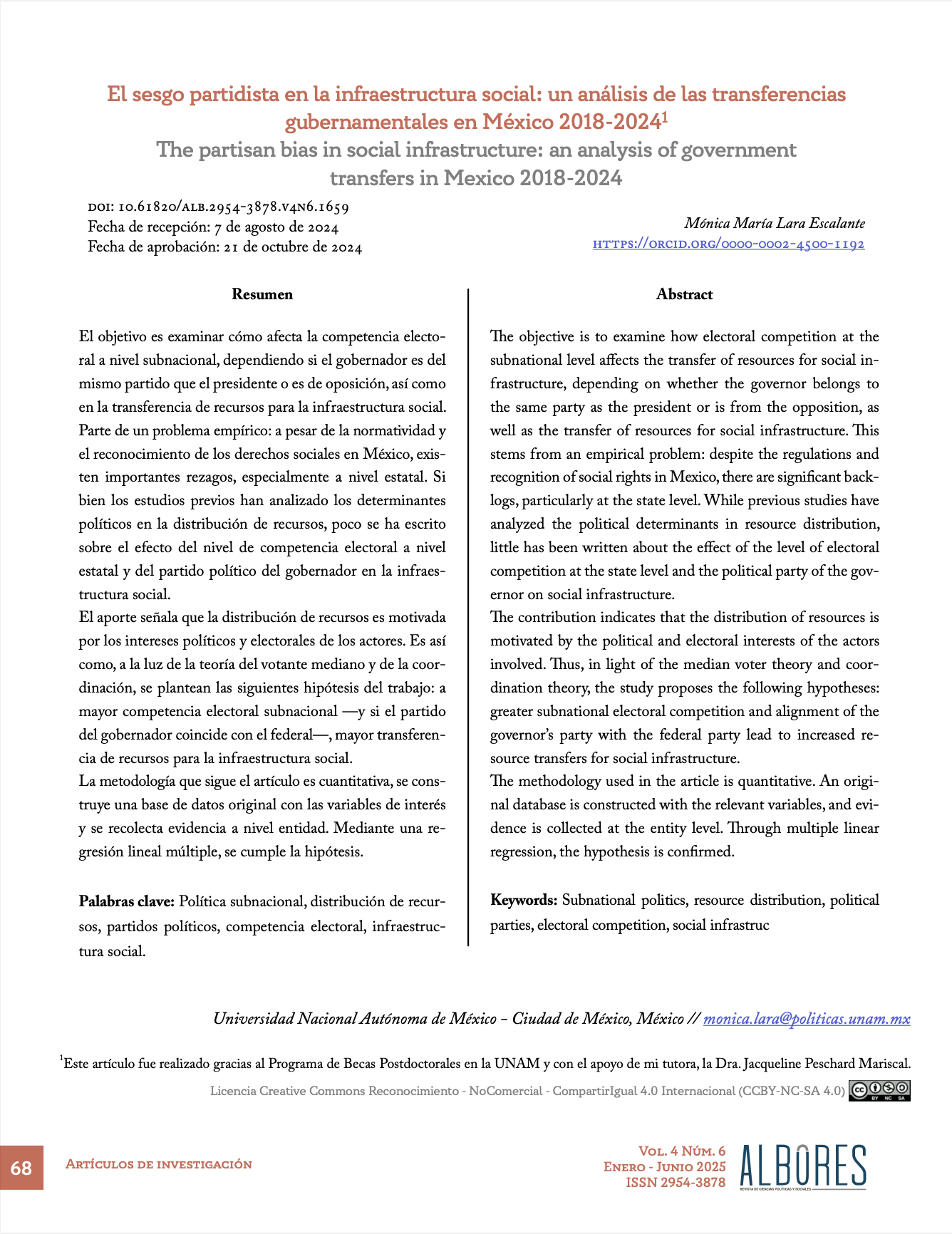
The objective is to examine how the configuration of the party system at the subnational level affects the transfer of resources for social infrastructure. Little has been written about the effect of the level of competition of the state-level party system on social development.
The working hypotheses are proposed: the greater the competition in the party system at the entity level and if the governor's party coincides with the federal party, the greater the transfer of resources. for social development.
An original database is built with the variables of interest. Using multiple linear regression, the hypothesis is met.
References
Anomaly, J. (2015). Public goods and government action. Politics, Philosophy & Economics, 14(2), 109-128.
Armesto, M. A. (2012). Gasto particularista en bienes públicos locales: índice de desviación. Revista mexicana de sociología, 74(3), 395-428.
Armesto, M. A. (2015). Competencia política y gasto particularista de los gobiernos subnacionales en México y Argentina. Latin American Research Review, 50(1), 160-183.
Arvate, P. R. (2013). Electoral Competition and Local Government Responsiveness in Brazil. World Development, 43, 67-83. https://doi.org/10.1016/j.worlddev.2012.11.004
Barreda, M., y Ruiz, L. (2017). Modos de representación en los distritos: ¿diputados al servicio de los partidos o de los electores? Los casos de Chile y Bolivia. Perfiles Latinoamericanos25(50), 155-177.
Baron, D. P. (1990). Distributive politics and the persistence of Amtrak. The Journal of Politics, 52(3), 883-913.
Barro, R. (1973). The Control of Politicians: An Economic Model. Public Choice, 14(1), 19-42.
Cámara de Diputados del Honorable Congreso de la Unión. (2004). Ley General de Desarrollo Social.https://www.diputados.gob.mx/LeyesBiblio/ref/lgds/LGDS_orig_20ene04.pdf
Chhibber, P., & Nooruddin, I. (2004). Do party systems count? The number of parties and government performance in the Indian states. Comparative political studies, 37(2), 152-187.
Colomer, J. M. (2009). Ciencia de la política. Una introducción. Ariel.
CONEVAL. 2022. Sistema de Información de Derechos Sociales. https://www.coneval.org.mx/Medicion/Paginas/Sistema-de-informacion-de-derechos-sociales.aspx
Costa-i-Font, J., Rodríguez-Oreggia, E., & Lunapla, D. (2003). Political competition and pork-barrel politics in the allocation of public investment in Mexico. Public choice, 116(1), 185-204.
Crisp, B., & Ingall, R. E. (2002). Institutional engineering and the nature of representation: Mapping the effects of electoral reform in Colombia. American journal of political science, 46(4),733-748.
Cox, G. W., & McCubbins, M. (1986). Electoral Politics as a Redistributive Game. Journal of Politics, 48, 370–89.
Cox, G. W., & McCubbins, M. D. (1993). Legislative leviathan: Party government in the House. University of California Press.
Cox, G., & McCubbins M. (2001). The Institutional Determinants of Economic Policy Outcomes. En Presidents, Parliaments and Policy, editado por Haggard, S. & McCubbins, M, 21-63. Cambridge University Press.
De Borger, B., & Kerstens, K. (1996). Cost efficiency of Belgian local governments: A comparative analysis of FDH, DEA, and econometric approaches. Regional science and urban economics, 26(2), 145-170.
De Mesquita, B. B., Smith, A., Siverson, R. M., & Morrow, J. D. (2005). The logic of political survival. MIT press.
Díaz-Cayeros, A., Estévez, F., & Magaloni, B. (2007). Strategies of vote buying: social transfers, democracy and welfare in Mexico. Unpublished book manuscript, Stanford University.
Dixit, A., & Londregan, J. (1996). The determinants of success of special interests in redistributive politics. The Journal of Politics, 58(4), 1132-1155.
Duflo, E., & Pande, R. (2007). Dams. The Quarterly Journal of Economics, 122(2), 601-646.
Ejdemyr, S., Kramon, E., & Robinson, A. L. (2018). Segregation, ethnic favoritism, and the strategic targeting of local public goods. Comparative Political Studies, 51(9), 1111-1143.
Ferejohn, J. (1974). Pork-Barrel Politics: Rivers and Harbors Legislation. Stanford University Press.
Ferejohn, J. (1986). Incumbent Performance and Electoral Control. Public Choice 50(1-3), 5-25.
Gant, M. M., & Luttbeg, N. R. (1987). The Cognitive Utility of Partisanship. Western Political Quarterly, 40(3), 499-517. https://doi.org/10.1177/106591298704000308
Harden, J. (2013). Multidimensional Responsiveness: The Determinants of Legislators Representational Priorities. Legislative Studies Quarterly,38(2), 155-184.
Heitschusen, V., Young, G., & Wood, D. (2005). Electoral Context and MP Constituency Focus in Australia, Canada, Ireland, New Zealand, and the United Kingdom. American Journal of Political Science, 49(1), 32-45.
Hirschman, A. (1983). La estrategia del desarrollo económico. El Trimestre Económico, 50(199(3)), 1331-1424.
Joanis, M. (2011). The road to power: partisan loyalty and the centralized provision of local infrastructure. Public Choice, 146, 117-143.
Jones, B. D. (1973). Competitiveness, Role Orientations, and Legislative Responsiveness. The Journal of Politics, 35(4), 924-947. https://doi.org/10.2307/2129214
Keefer, P., & Khemani, S. (2009). When Do Legislators Pass on Pork? The Role of Political Parties in Determining Legislator Effort. American Political Science Review, 103(01), 99-112. https://doi.org/10.1017/S0003055409090054
Kerevel, Y. P. (2015). Pork-Barreling without Reelection? Evidence from the Mexican Congress. Legislative Studies Quarterly, 40(1), 137-166.
Lindbeck, A., & Weibull, J. W. (1987). Balanced-budget redistribution as the outcome of political competition. Public choice, 273-297.
Livert, F., Gainza, X., & Acuña, J. (2019). Paving the electoral way: Urban infrastructure, partisan politics and civic engagement. World D e v e l o p m e n t , 1 2 4. https://doi.org/10.1016/j.worlddev.2019.104628
Mancini, F. (2018). La pobreza y el enfoque de derechos: algunas reflexiones teóricas. En Hernandez, G., Aparicio, R. y Mancini, F. (Eds.), Pobreza y Derechos Sociales en México (29-83). Consejo Nacional de Evaluación de la Política de Desarrollo Social y Universidad Nacional Autónoma de México.
Marshall, T. H. (1965). Citizenship and social class. En T. H. Marshall, Citizenship and social development. Doubleday Anchor Books.
Meseguer, C., y Aparicio, J. (2012). Migration and distributive politics: the political economy of Mexico's 3×1 Program. Latin American Politics and Society, 54(4), 147-178.
Meserve, S., Robbins, J., & Thames, F. (2017). Multiple principals and legislative cohesion. Legislative Studies Quarterly, 42(4), 515-548.
Midgley, J. O. (1995). Social development: The developmental perspective in social welfare. SAGE Publications.
Montgomery, D. C., Peck, E. A., & Vining, G. G. (2012). Introduction to linear regression analysis. Wiley.
Munck, G. y Verkuilen, J. (2005). Research Designs. Encyclopedia of Social Measurement. Volume 3, 385-395, Academic Press.
Nussbaum, M. (1997). Capabilities and human rights. Fordham Law Review, 66(2), 273-300
Olson, M. (2002).The Logic of collective action: Public Goods and the Theory of Groups. Harvard University Press.
Ponce, A. F., y de Lira, H. D. (2018). La política del gasto público estatal en México: el rol de la fragmentación legislativa y del gobierno dividido. Revista SAAP, 12(2), 21-30.
Ponce-Rodríguez, R. A. (2013). Efectos de las fórmulas para las transferencias inter-gubernamentales en el tamaño del gobierno federal. EconoQuantum,10(1), 37-58.
Ríos-Núñez, K. (2020). Determinantes políticos y económicos del gasto público subnacional en México. De Política, (13), 49-68.
Rosas, G., Johnston, N. P., & Hawkins, K. (2013). Local public goods as vote-purchasing devices? Persuasion and mobilization in the choice of clientelist payments. Journal of Theoretical Politics, 26(4), 573-598. https://doi.org/10.1177/0951629813511549
Samuelson, P. A. (1954). The Pure Theory of Public Expenditure. The Review of Economics and Statistics, 36(4), 387-389. https://doi.org/10.2307/1925895
Sánchez-Martínez, J. (2021). Ideología partidista y gasto público en Jalisco. Espiral,28(81), 79-111. https://www.scielo.org.mx/scielo.php?script=sci_arttext&pid=S1665-05652021000200079
Sarafoglou, N., Andersson, A. M., Holmberg, I., & Ohlsson, O. (2006). Spatial infrastructure and productivity in Sweden. Yugoslav Journal of Operations Research, 16(1), 67-83.
Secretaría de Gobernación. (2020). Decreto por el que se reforma y adiciona el artículo 4º. de la Constitución Política de los Estados Unidos Mexicanos. https://dof.gob.mx/nota_detalle.php?codigo=5593045&fecha=08/05/2020#gsc.tab=0
Sen, A. (1999). Development as freedom. Oxford University Press.
Soto-Zazueta, I. M. (2016). El efecto de la competencia política sobre la provisión de bienes públicos locales en México. Revista de Ciencia Política, 36(3), 749-772. https://doi.org/10.4067/S0718090X2016000300007
Soto-Zazueta, I., y Figueroa-Elenes, J. (2018). Estimación del efecto de la alternancia sobre la provisión de servicios públicos locales en México. Economía, sociedad y territorio, 18(56), 195-231. https://doi.org/10.22136/est2018957
Soto-Zazueta, I., y Piña, G. (2022). Transferencias locales y su relación con la alternancia política en México. Revista Venezolana de Gerencia 27(100), 1666-1684. https://doi.org/10.52080/rvgluz.27.100.23
Velázquez, C. (2006). Determinantes del gasto estatal en México. Gestión y Política Pública, 15(1), 83-108. http://hdl.handle.net/11651/3015

This work is licensed under a Creative Commons Attribution-NonCommercial-ShareAlike 4.0 International License.
Copyright (c) 2025 Albores