
Keywords
social economy
productive inclusion
How to Cite
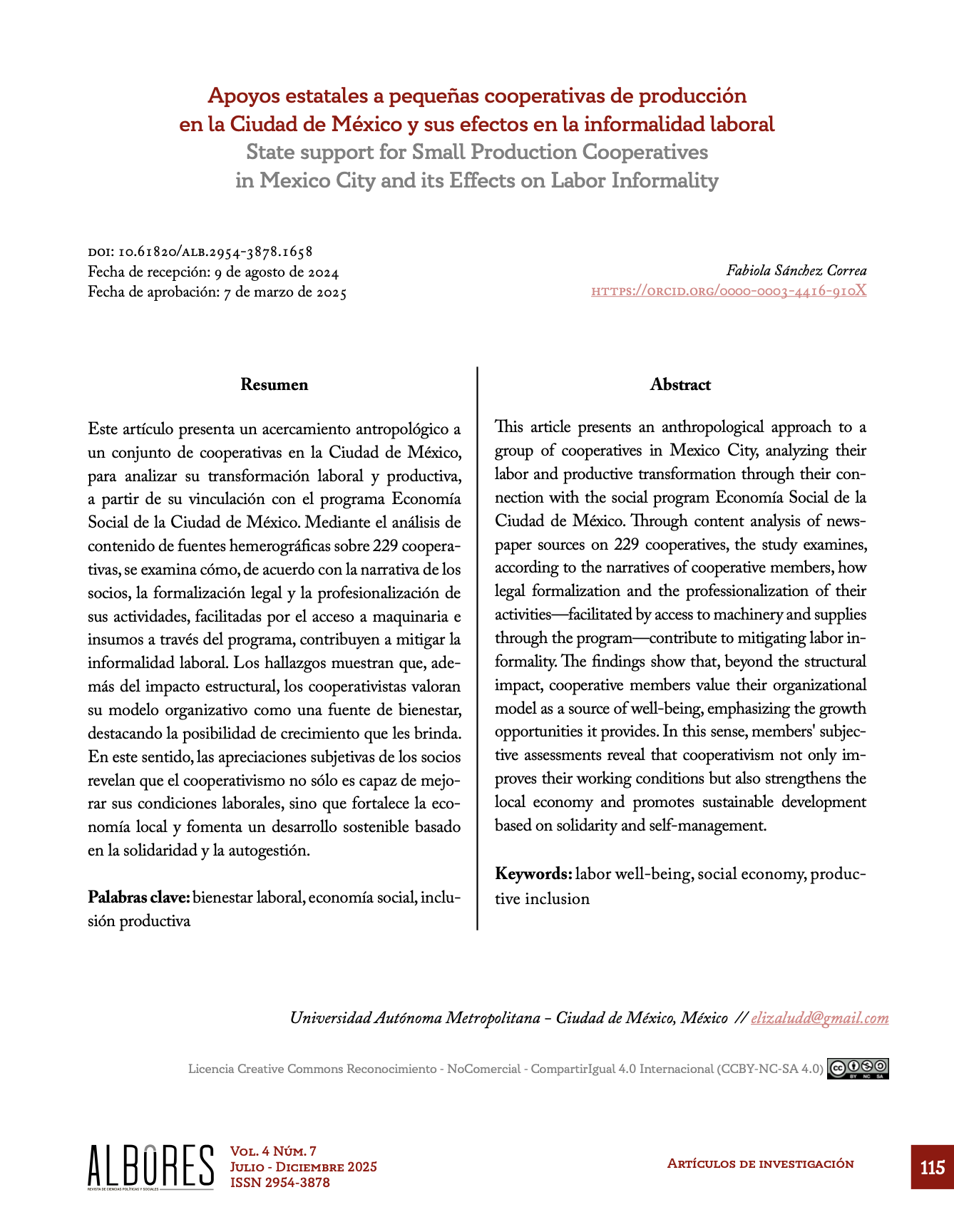
Abstract
This article presents an anthropological approach to the study of a group of cooperatives in Mexico City, analyzing their labor and productive transformation through their connection with the social program Economía Social de la Ciudad de México. Through content analysis of newspaper sources on 229 cooperatives, the study examines, according to the narratives of cooperative members, how legal formalization and the professionalization of their activities—facilitated by access to machinery and supplies through the program—contribute to mitigating labor informality.
References
Breman, J. (2020). Informality: The bane of the labouring poor under globalized capitalism, en M. Chen y F. Carré (Eds.), The informal economy revisited: Examining the past, envisioning the future (31-37). Routledge.
Bonnet, F., Vanek, J. & Chen, M. (2019). Women and men in the informal economy: A statistical brief. WIEGO. https://www.wiego.org
Chen, M.A. (2009). Informalization of labour markets: Is formalization the answer?, en S. Razavi (Ed.), The gendered impacts of liberalization (207-234). Routledge.
Chen, M.A., Plagerson, S. & Alfers, L. (2022). A new social contract inclusive of informal workers. UNU-WIDER. https://doi.org/10.35188/UNU-WIDER/2022/180-8
Hart, K. (2008). Between bureaucracy and the people: A political history of informality. Danish Institute for International Studies (DIIS). Gobierno de la Ciudad de México. (2023). Programa Economía Social de la Ciudad de México. Gaceta Oficial de la Ciudad de México, 1266, 1-48. https://trabajo.cdmx.gob.mx/storage/app/media/ reglasdeoperacion2024go.pdf
(Inaes) Instituto Nacional de la Economía Social. (2021). Informe general: Foro global GSEF2021. Gobiernos locales y economía social: Co-creación de rutas para una economía verde e inclusiva. Instituto Nacional de la Economía Social. https://trabajo.cdmx.gob.mx/storage/app/media/INFOR-ME_GRL_GSEF2021.pdf
(Inaes) Instituto Nacional de la Economía Social. (2021a). Rutas y retos para potenciar las ESS. Foro global GSEF2021: Gobiernos locales y economía social: Co-creación de rutas para una economía verde e inclusiva. Instituto Nacional de la Economía Social. https://trabajo.cdmx.gob.mx/storage/app/media/Rutas_Retos_ESS-201221.pdf
Montoya, C.A., Arango, J., Vásquez, M., Ortega, A., Pérez, P. y Uribe, V. (2023). Perspectiva del trabajo digno y decente en las empresas de economía social y solidaria: Su aporte al desarrollo sostenible en la ciudad de Medellín y Ciudad de México. Universidad Nacional Autónoma de México, Facultad de Contaduría y Administración.
Rojas, J. (2022). Panorama asociativo, arquitectura institucional y políticas públicas de fomento cooperativo en México durante las primeras dos décadas del siglo XXI, en F. Correa (Ed.), Instituciones y políticas públicas para el desarrollo cooperativo en América Latina (333-371). Comisión Económica para América Latina y el Caribe (CEPAL).
Rojas, J. (2023). Límites y contradicciones del Programa de Fomento a la Economía Social 2021-2024 en México. Boletín de la Asociación Internacional de Derecho Cooperativo, (62), 71-93. https://doi.org/10.18543/baidc.2489
Rojas, J. y Cañedo, R. (2020). Políticas de fomento de la economía social y solidaria: estudio de caso de la Ciudad de México. UNRISD, Geneva.

This work is licensed under a Creative Commons Attribution-NonCommercial-ShareAlike 4.0 International License.
Copyright (c) 2025 Albores