Keywords
estudiantes universitarios
percepciones del profesorado
salud mental
educación superior
How to Cite
Abstract
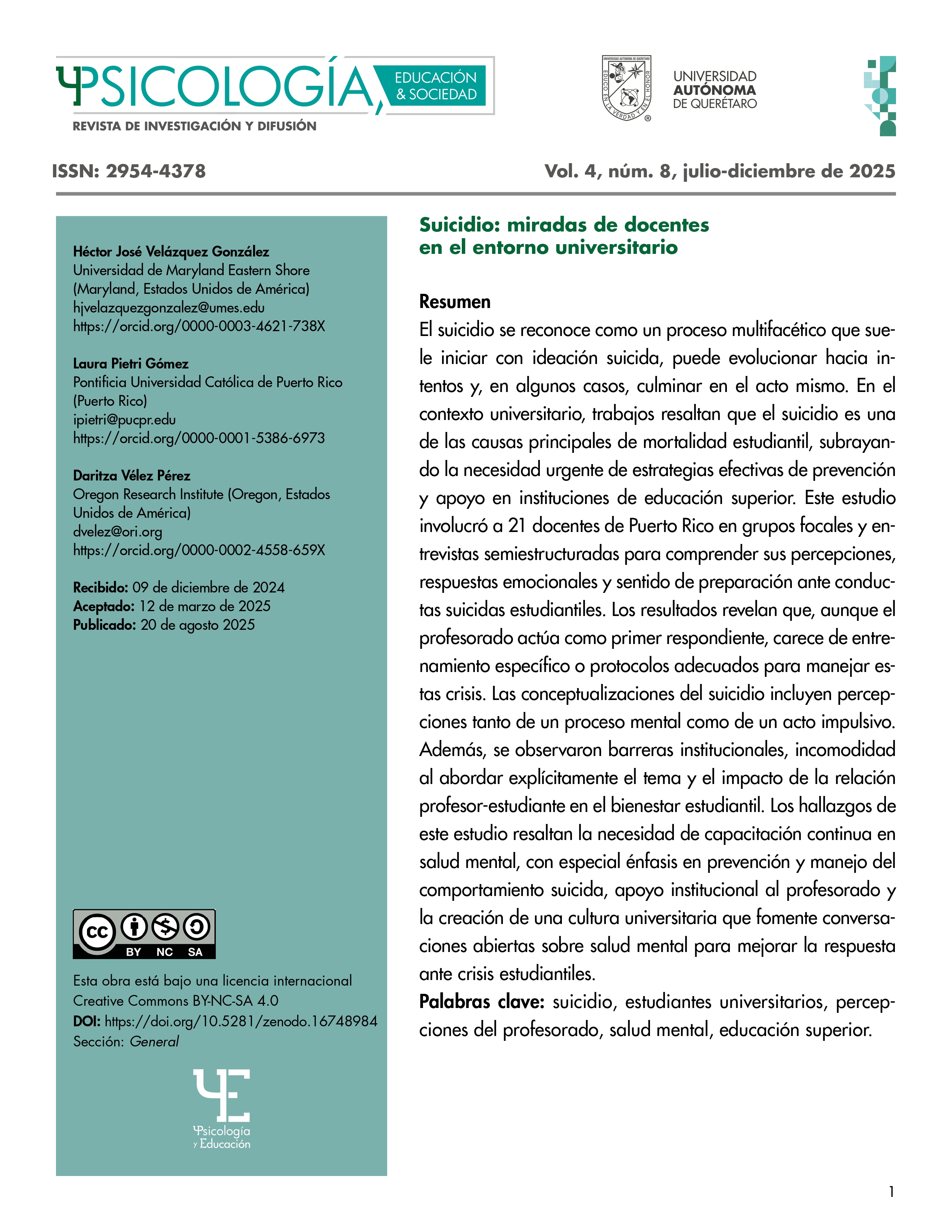
This study explores the complex phenomenon of suicide among university students, focusing on faculty perspectives regarding this issue. Suicide is recognized as a multifaceted process that often begins with suicidal ideation, may evolve into attempts, and can culminate in the act itself. Recent data from the Centers for Disease Control and Prevention (CDC, 2024) highlight suicide as the second leading cause of death among individuals aged 10 to 34 in the United States. Globally, the World Health Organization (WHO, 2024) reports suicide as the third leading cause of death among those aged 15 to 29. Within the university setting, studies emphasize that suicide remains one of the primary causes of student mortality, underscoring the urgent need for effective prevention and support strategies in higher education institutions (Cecchin et al., 2024; Lázaro-Pérez et al., 2024).
Through a qualitative approach, this study engaged 21 university faculty members in focus groups and in-depth interviews to understand their perceptions, emotional responses, and sense of preparedness in addressing suicidal behaviors among students. Findings reveal that while faculty often serve as first responders, they generally lack specific training or protocols for effectively managing student crises. Faculty members expressed varied views of suicide, including conceptualizations of it as both a mental process and an impulsive act. Significant discomfort around explicitly naming suicide, perceived barriers within institutional support systems, and the impact of faculty-student relationships on student well-being were also noted.
This research highlights the need for continuous mental health training, institutional support for faculty, and the fostering of a campus culture that encourages open discussion about mental health. These initiatives can help bridge the gap in institutional responses to student crises, ensuring a safer, more supportive educational environment.

This work is licensed under a Creative Commons Attribution-NonCommercial-ShareAlike 4.0 International License.
Copyright (c) 2025 Psicología, Educación & Sociedad