

Keywords
professionalization
stage language
space-light
How to Cite
Abstract
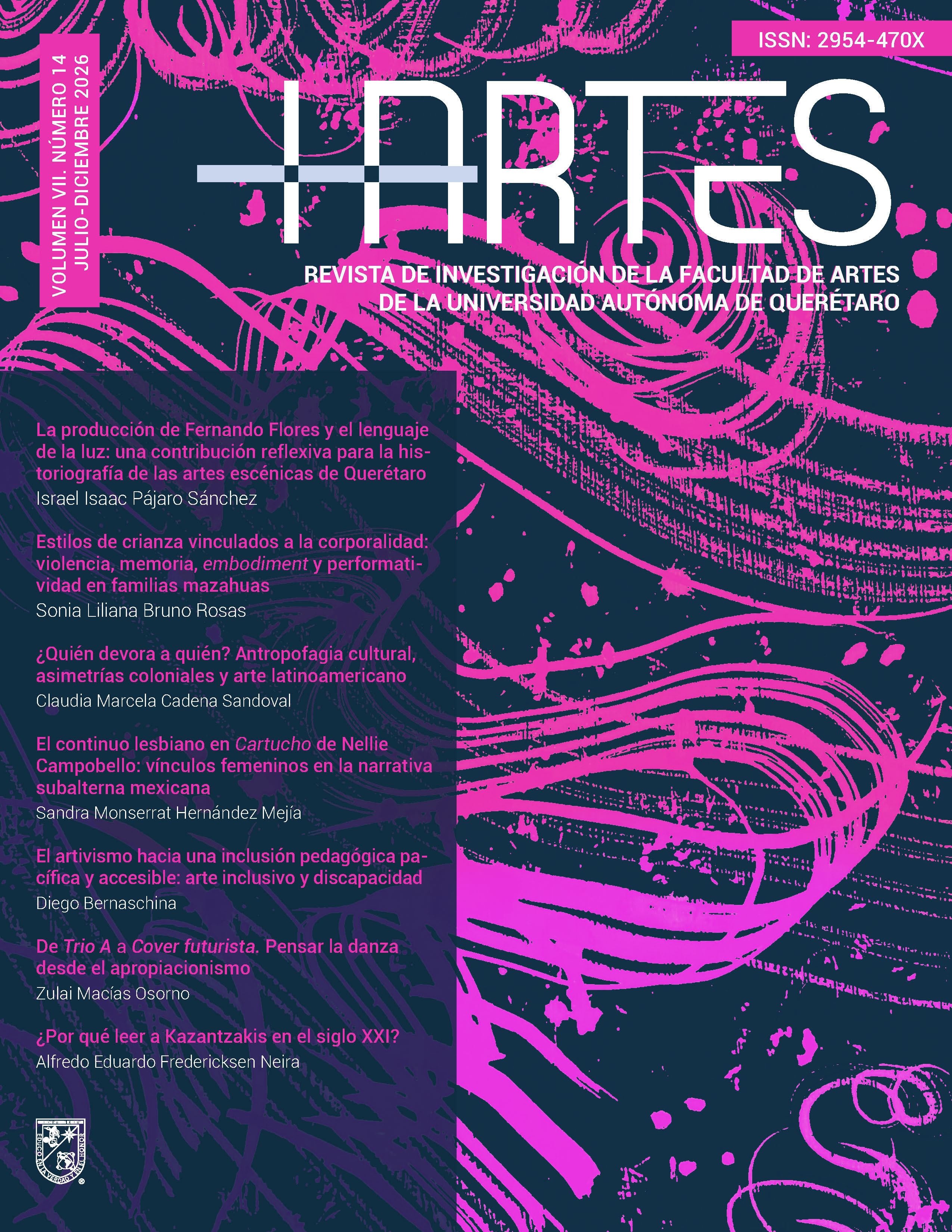
This article examines the contribution of set and lighting designer Fernando Flores in the history of performing arts in Querétaro. This is because historical accounts of this discipline focus primarily on traditional companies, stage directors, choreographers, actors, and dancers, thereby perpetuating a narrative that overlooks the work of creators specializing in stagecraft. These reconstructions are interpreted as symptomatic of how theatrical practice was and continues to be understood in the region, where creative teams are relegated to a secondary role or become dispensable in productions. This situation leads us to question the professional level of these productions.
It is proposed that the development of specialized creative teams is inseparable from professional practice. Flores' career demonstrates this through his sustained commitment, rigor, and excellence, as each of the companies he collaborated with significantly elevated the quality of their productions. Flores' profile is rooted in the scenography vision of modern theater and contemporary dance, but this did not prevent him from investigating the nature of space-light—his artistic medium—to engage in dialogue at technical, aesthetic, and poetic levels. Through sustained research into and experimentation with the sensory, physical, and emotional effects of the light-spatial phenomenon, this set designer opened new lines of research and creation oriented toward approaches that transcend the opposition between science and art. Ultimately, Flores developed a distinctive artistic language and methodology for expressing himself through his element in staging.
References
Artaud, A. (2011). El teatro y su doble. Ediciones Incógnita.
Bachelard, G. (2000). La poética del espacio. Fondo de Cultura Económica.
Bravo, U. (Director). (1999). Titus Andronicus [Representación teatral]. Centro de Formación y Producción Teatral de Querétaro, Querétaro, México.
Camargo, A. (30 de agosto de 2003). Blanco y Negro: obra que rescata el sentido trágico de la vida. Diario de Querétaro.
Cato, I. (13 de marzo de 2019). Compañías queretanas: Cómicos de la Legua y Corral de Comedias. Revista Proceso. https://www.proceso.com.mx/cultura/2019/3/13/companias-queretanas-comicos-de-
la-legua-corral-de-comedias-221618.html
Centro Nacional de Danza Contemporánea. (31 de agosto de 2021). CENADAC/// Retrospectiva de Ballet Nacional de México [Video]. YouTube. https://www.youtube.com/watch?v=khZ8IRpfMQU&t=47s
Chávez, A. (Director). (2014). Kinética [Representación teatral]. Ciudad Interior, Querétaro, México.
Dallal, A. (2022). Epicentro: Guillermina Bravo y el Ballet Nacional de México. Instituto de Investigaciones Estéticas; Universidad Nacional Autónoma de México.
Dallal, A. (1988). Cómo acercarse a la danza. Plaza y Valdés Editores.
Elizondo, A. (27 de marzo de 2025). Más allá del telón: desafíos y fortalezas del teatro en Querétaro. Diario de Querétaro. https://oem.com.mx/diariodequeretaro/cultura/mas-alla-del-telon-desafios-y-fortalezas-del-teatro-en-queretaro-22297996
García, R. (Director). (2007). La mano del lobo: Mozart [Representación teatral]. Globe Teatro, Querétaro, México.
Hinton, C. H. (1993). The Fourth Dimension. Health Research.
Naredo, M. ( 2024). La Historia del teatro en Querétaro. Revista Asomarte Querétaro, (239), 24-37. https://issuu.com/asomarte/docs/aso_mar_2024_web
Ladrón de Guevara, M. (2010). Artistas Queretanos: Cinco años de entrevistas en Barroco, suplemento cultural del Diario de Querétaro. Diario de Querétaro; DRT Fundación; Instituto Queretano de la Cultura y las Artes; Universidad Autónoma de Querétaro.
Lehmann, H. (2013). Teatro posdramático. Paso de Gato; CENDEAC.
Malpica, A. (2003). Blanco y negro. Fondo Editorial de Querétaro.
Ouspensky, P. D. (2005). The Fourth Dimension. Kessinger Publishing.
Pinela, J. (2014). Raúl Zermeño. El teatro como utopía y proyecto de vida. Paso de Gato: Revista Mexicana de Teatro, (57), 6-10. https://pasodegato.com/revistas/paso-de-gato/
Traverso, E. (2023). La historia como campo de batalla: Interpretar las violencias del siglo XX. Fondo de Cultura Económica.
Usigli, R. (1966). Anatomía del teatro. Ecuador O ̊O' O".
Wirth, H. A. (2004). La fe de los cerdos. Fondo Editorial de Querétaro.
Zumthor, P. (2006). Atmósferas: entornos arquitectónicos - las cosas a mi alrededor. Editorial Gustavo Gili.

This work is licensed under a Creative Commons Attribution-NonCommercial-ShareAlike 4.0 International License.
Copyright (c) 2026 HArtes