

Keywords
body
embodiment
memory
violence
Mazahua culture
How to Cite
Abstract
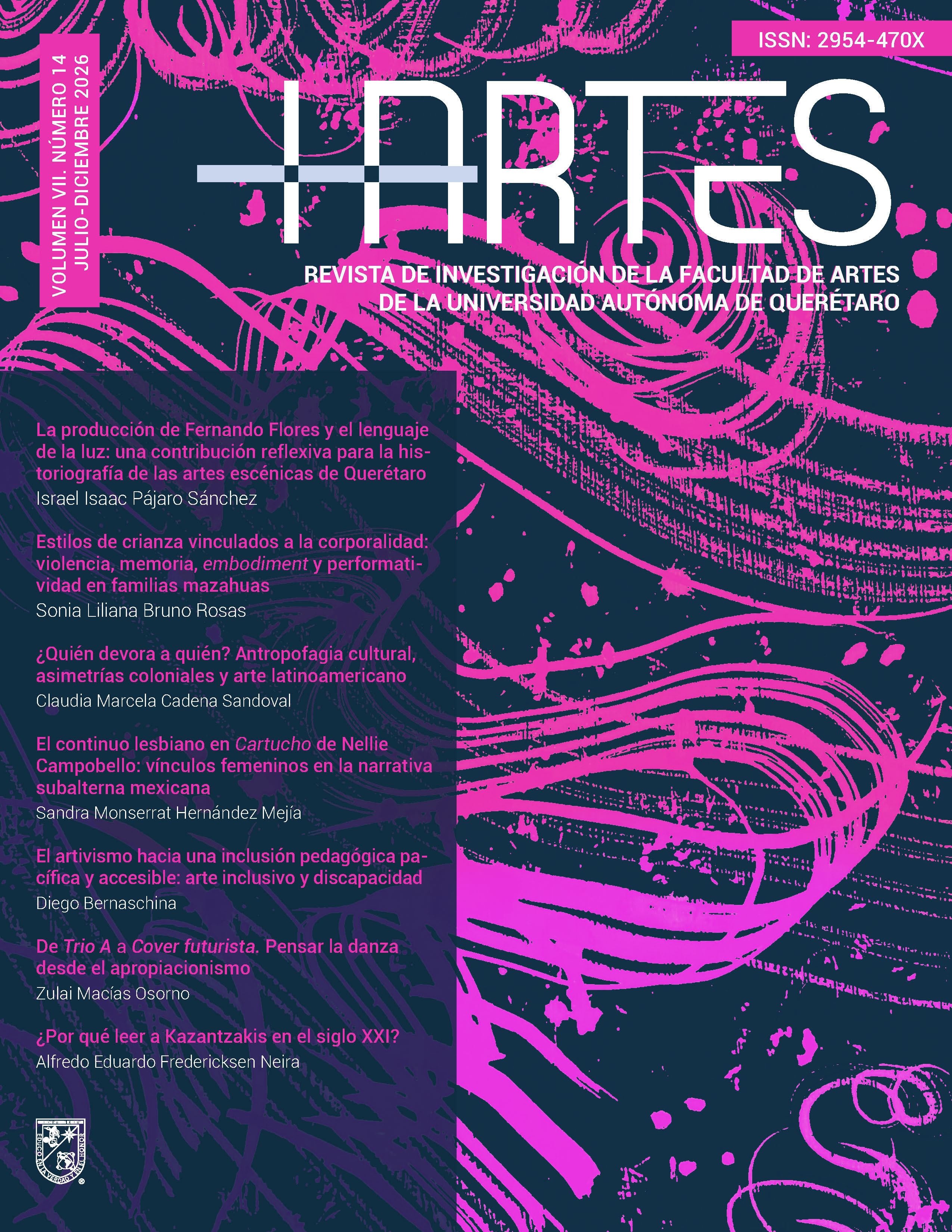
This article analyzes how parenting styles among Mazahua families in San Felipe del Progreso, a municipality located in the northern region of the State of Mexico, generate and sustain violent practices. These practices are inscribed on the bodies of children and adults, persisting as embodied memory and performativity throughout their lives. Using a qualitative methodology based on genealogies, participant observation, and life histories, the study documents the intergenerational transmission of authoritarian, neglectful, democratic, and permissive parenting styles, emphasizing their emotional, physical, and symbolic impacts. Furthermore, the article explores how the body becomes both a repository and a living archive of violence (Gómez Sánchez & Bruno Rosas, 2025), while memory enables the recollection and reconstruction of childrearing experiences (Pérez-Taylor, 2012) from the perspectives of gender and Mazahua culture. The analysis also draws on the concept of embodiment, understanding both memory and the body as sites where violence is inscribed and experienced. From this perspective, parenting emerges as a performative field in which structures of domination are not only reproduced but also contested and resisted.
References
Baumrind, D. (1966). Effects of authoritative parental control on child behavior. Child Development, 37(4), 887-907. https://www.jstor.org/stable/1126611?origin=crossref
Butler, J. (2007). Gender Trouble. Routledge.
Fox, R. (1967). Sistemas de parentesco y matrimonio. Alianza Editorial.
Galtung, J. (1996). Violence, Peace, and Peace Research. Journal of Peace Research, 6(3), 167-191. https://journals.sagepub.com/doi/10.1177/002234336900600301
Gómez Sánchez, D. (2019). El cuerpo, un análisis desde la lengua y la cultura otomí. Revista Peruana de Antropología, 4(5), 26-34. https://www.researchgate.net/publication/342587948_El_cuerpo_un_analisis_desde_la_lengua_y_la_cultura_otomi_The_body_an_analysis_from_the_Otomi_language_and_culture
Gómez Sánchez, D., y Bruno Rosas, S. L. (2025). Cuerpo, memoria y emociones: el dominio masculino en los mazahuas de San Felipe del Progreso, México. EntreDiversidades, 22, 1-20. https://doi.org/10.31644/ED.IEI.V22.2025.A01
Guber, R. (2011). La etnografía, método, campo y reflexividad. Grupo Editorial Norma.
Gurung, L. (2020). Feminist Standpoint Theory: Conceptualization and Utility. Dhaulagiri Journal of Sociology and Anthropology, 14, 106-115. https://www.researchgate.net/publication/348330542_Feminist_Standpoint_Theory_Conceptualization_and_Utility
Kaplan, C. V. (2006). Violencias en plural: sociología de las violencias en la escuela. Miño y Dávila.
Latour, B. (2008). Reensamblar lo social: una introducción a la teoría del actor-red. Ediciones Manantial.
Le Breton, D. (2002). Antropología del cuerpo y modernidad. Nueva Visión.
Maccoby, E. E., y Martin, J. A. (1983). Socialization in the context of the family: Parent-child interaction. En P. H. Mussen y E. M. Hetherington (Eds.), Handbook of child psychology: Vol. 4. Socialization, personality, and social development (pp.1-101). Wiley.
Peral Rabasa, F. J. (2017). Cuerpo, cognición y experiencia: embodiment, un cambio de paradigmas. Dimensión Antropológica, 69, 15-47. https://revistas.inah.gob.mx/index.php/dimension/article/view/11709
Perera, E. (2005). Sistematización crítica de la teoría de las representaciones sociales [Tesis doctoral]. Universidad de la Habana.
Pérez-Taylor, R. (2012). Entre la tradición y la modernidad. Plaza y Valdés.
Sahagún, B. (1989). Historia general de las cosas de la Nueva España. Porrúa.
Uribe Roncallo, P. (2020). Masculinidades Alternativas: Varones que se Narran al margen del Modelo Hegemónico y Generan Cambios a través de la Educación. Revista Latinoamericana de Educación Inclusiva, 14(2), 115-129. https://www.scielo.cl/scielo.php?script=sci_arttext&pid=S0718-73782020000200115
Wieviorka, M. (2006). La violencia: destrucción y constitución del sujeto. Espacio abierto, 15(1), 239-248. https://www.redalyc.org/articulo.oa?id=12215214
Wright-Carr, D. C. (2018). La ciencia cognitiva corporeizada: Una perspectiva para el estudio de los lenguajes visuales. Entreciencias: Diálogos en la Sociedad del Conocimiento, 6(16), 81-96. https://doi.org/10.22201/enesl.20078064e.2018.16.63364

This work is licensed under a Creative Commons Attribution-NonCommercial-ShareAlike 4.0 International License.
Copyright (c) 2026 HArtes